算法设计------利用并查集检测无向图的环

并查集

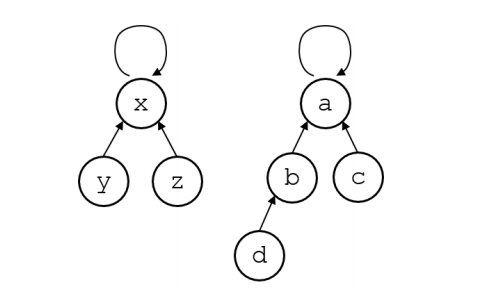
定义:并查集是一种树型的数据结构,用于处理一些不相交集合(Disjoint Sets)的合并及查询问题。常常在使用中以森林来表示。

核心思想

  • 以一颗有根树代表每个集合。
  • 每个节点维护一个指向其父节点的链接。
  • 对于每个集合根节点为该集合的代表。
  • 例如: 集合{x,y,z}和{a,b,c,d}。

主要操作

  • Find(X):查找元素X所在集合,可用于确定两个元素是否在相同的子集中。
  • Union(x,y):将元素x,y所在的两个集合中合并为一个集合。

并查集实现

简单实现

1
2
3
4
5
6
7
8
9
10
11
12
13
14
15
// Naive implementation of find
int find(int parent[], int i)
{
if (parent[i] == i)
return i;
return find(parent, parent[i]);
}

// Naive implementation of union()
void Union(int parent[], int x, int y)
{
int xset = find(parent, x);
int yset = find(parent, y);
parent[xset] = yset;
}

上面的Union()和Find()实现,最坏的情况下,会产生一个很深的树,成一个链表,find()的时间复杂度是线性的O(n)。以下是一个最坏情况的示例:

1
2
3
4
5
6
7
8
9
10
11
12
13
14
15
16
17
18
19
20
21
22
23
24
25
假设有四个元素0,1,2,3

最初每个元素为一个单元素子集
0 1 2 3

执行 Union(0, 1)
1 2 3
/
0

执行 Union(1, 2)
2 3
/
1
/
0

执行 Union(2, 3)
3
/
2
/
1
/
0

Union()优化:按秩合并

按秩合并,即合并时总是在更深的树根下附加更小深度的树。此时,最坏情况下,find()的时间复杂度为O(Logn)。以下为按秩合并示例:

1
2
3
4
5
6
7
8
9
10
11
12
13
14
15
16
17
最初每个元素为一个单元素子集
0 1 2 3

执行 Union(0, 1)
1 2 3
/
0

执行 Union(1, 2)
1 3
/ \
0 2

执行 Union(2, 3)
1
/ | \
0 2 3

find()优化:路径压缩

路径压缩,即在执行find(x)时,“顺便”将x的父节点改为查找到的根节点,以后再调用find(x)就只需O(1)的时间且如果x是子树的根,那么子树的所有节点到根节点的路径都会被压缩。

1
2
3
4
5
6
7
8
9
10
11
12
13
14
15
16
假设在如下子集调用find(3)
9
/ | \
4 5 6
/ \ / \
0 3 7 8
/ \
1 2

在执行find(3)时,我们“顺便”将3的父节点指向9,当下一次调用find()参数为1,2,3时,其到根节点的路径都会被压缩。

9
/ / \ \
4 5 6 3
/ / \ / \
0 7 8 1 2

按秩合并和路径压缩两种优化下的并查集,find()的时间复杂度小于O(Logn)。

并查集应用——检测无向图中的环

原理:对于图的每个边,找到每个边的两个顶点集,如果两个顶点集相同,则找到一个环。

C语言实现

1
2
3
4
5
6
7
8
9
10
11
12
13
14
15
16
17
18
19
20
21
22
23
24
25
26
27
28
29
30
31
32
33
34
35
36
37
38
39
40
41
42
43
44
45
46
47
48
49
50
51
52
53
54
55
56
57
58
59
60
61
62
63
64
65
66
67
68
69
70
71
72
73
74
75
76
77
78
79
80
81
82
83
84
85
86
87
88
89
90
91
92
93
94
95
96
97
98
99
100
101
102
103
104
105
106
107
108
109
110
111
112
113
114
115
116
117
118
119
120
121
122
123
124
125
126
127
128
129
#include <stdio.h>
#include <stdlib.h>

// 边结构
struct Edge
{
int src, dest;
};

// 图结构
struct Graph
{
// V-> 顶点的数量, E-> 边的数量
int V, E;

// 图是一个边的集合
struct Edge* edge;
};

struct subset
{
int parent;
int rank;
};

// 创建图
struct Graph* createGraph(int V, int E)
{
struct Graph* graph = (struct Graph*) malloc( sizeof(struct Graph) );
graph->V = V;
graph->E = E;

graph->edge = (struct Edge*) malloc( graph->E * sizeof( struct Edge ) );

return graph;
}

// 以路径压缩方式实现find()
int find(struct subset subsets[], int i)
{
// find root and make root as parent of i (path compression)
if (subsets[i].parent != i)
subsets[i].parent = find(subsets, subsets[i].parent);

return subsets[i].parent;
}

// 以按秩合并实现Union()
void Union(struct subset subsets[], int x, int y)
{
int xroot = find(subsets, x);
int yroot = find(subsets, y);

// 在更深的树的根下附加更浅的树
if (subsets[xroot].rank < subsets[yroot].rank)
subsets[xroot].parent = yroot;
else if (subsets[xroot].rank > subsets[yroot].rank)
subsets[yroot].parent = xroot;

// 两个树的深度相同,rank++
else
{
subsets[yroot].parent = xroot;
subsets[xroot].rank++;
}
}

//检测给定图中是否有环
int isCycle( struct Graph* graph )
{
int V = graph->V;
int E = graph->E;

// 每个顶点初始化为一个集合
struct subset *subsets =
(struct subset*) malloc( V * sizeof(struct subset) );

for (int v = 0; v < V; ++v)
{
subsets[v].parent = v;
subsets[v].rank = 0;
}


// 遍历图的所有边,找到每个边的两个顶点集,如果集相同,则在图中有循环。
for(int e = 0; e < E; ++e)
{
int x = find(subsets, graph->edge[e].src);
int y = find(subsets, graph->edge[e].dest);

if (x == y)
return 1;

Union(subsets, x, y);
}
return 0;
}

//测试代码
int main()
{
/* 创建如下图
0
| \
| \
1-----2 */

int V = 3, E = 3;
struct Graph* graph = createGraph(V, E);

// 边 0-1
graph->edge[0].src = 0;
graph->edge[0].dest = 1;

// 边 1-2
graph->edge[1].src = 1;
graph->edge[1].dest = 2;

// 边 0-2
graph->edge[2].src = 0;
graph->edge[2].dest = 2;

if (isCycle(graph))
printf( "Graph contains cycle" );
else
printf( "Graph doesn't contain cycle" );

return 0;
}

如果对你有帮助的话,Star✨下一吧!